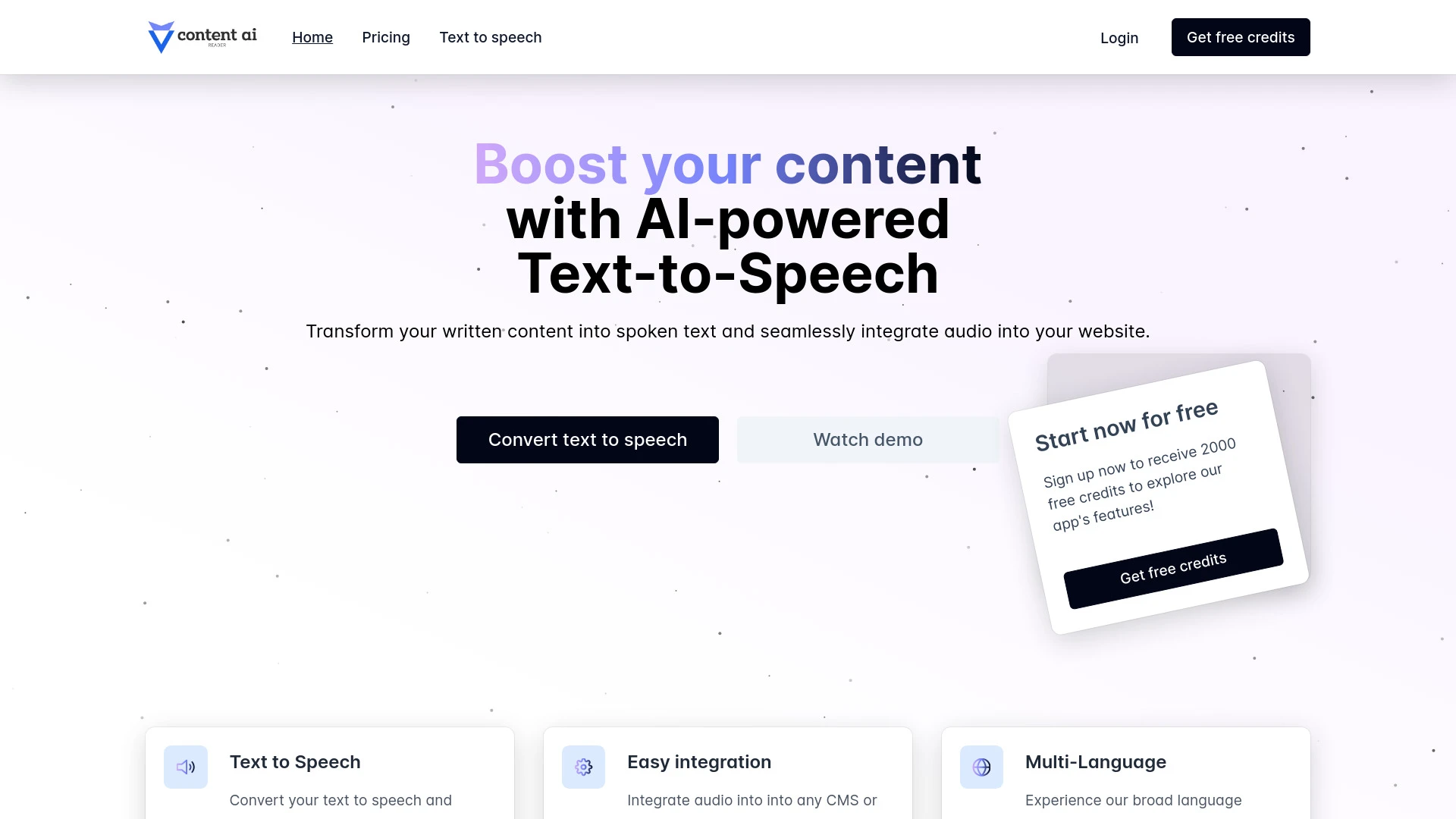
Audioread and Content AI Reader both convert text to audio, but they serve different audiences. Audioread targets individuals seeking convenient personal listening during tasks like workouts or commutes, while Content AI Reader targets websites and publishers aiming to boost accessibility with multilingual and dynamic audio content.
Multitasking while exercising or working out
listening to articles during cooking or other hands-on activities
making commutes productive by consuming content as audio
converting blog posts into podcast episodes for easy listening.
Convenient way to consume text content
supports multitasking
offers high-quality audio experience
Text-to-speech conversion
ultra-realistic AI voices
compatibility with podcast apps and browsers
conversion of various text formats
hands-free listening
Transform blog posts and articles into engaging audio formats
Provide audio versions of news articles for better accessibility
Enhance user experience on educational platforms
Generate audio content for e-commerce product descriptions
Boosts website accessibility
Enhances engagement with audio content
Supports multiple languages
Text-to-speech conversion
Easy integration into various platforms
Multi-language support
Dynamic voiceover for content
Final verdict: The winner depends on the use case. If the priority is personal, on the go audio of text for individuals, Audioread offers best fit with high fidelity voices and convenient web compatibility. If the priority is website accessibility and platform wide audio content, Content AI Reader provides stronger integration, multilingual support, and dynamic voiceover features. In practice, many teams benefit from using both in tandem depending on use case.
Pricing and subscription plans: Audioread lists a price of 0.00 paid with monthly billing and a subscription model, suggesting continuous access to its TTS features. Content AI Reader is described as 0.00 freemium with monthly billing and a subscription model, indicating a free tier plus paid enhancements. In both cases the model emphasizes ongoing access, with Content AI Reader offering an easier entry point through its freemium option.
Performance metrics: Explicit speed or reliability metrics are not provided in the data. Audioread highlights ultra realistic AI voices and compatibility with popular apps, which implies strong voice quality and stable performance; Content AI Reader emphasizes multi language support and dynamic voiceover, suggesting flexible delivery and scalable accessibility across platforms.
User experience: Audioread offers a straightforward process of uploading text and selecting an AI voice, yielding a hands free listening workflow across web browsers and podcast apps. Content AI Reader focuses on easy integration and audio widgets delivery, supporting a broad language set and dynamic voice options, which can enhance onboarding for publishers and developers. The learning curve for both appears modest, with Audioread emphasizing a user friendly interface and Content AI Reader emphasizing integration simplicity.
Integrations and compatibility: Audioread is built for web based use with compatibility with podcast apps and browsers; Content AI Reader offers easy integration into various platforms and supports multi language content.
Limitations and drawbacks: Audioread centers on personal consumption and may depend on external platforms for podcast distribution, while Content AI Reader focuses on website integration which may require ongoing maintenance for widget updates and multilingual assets.