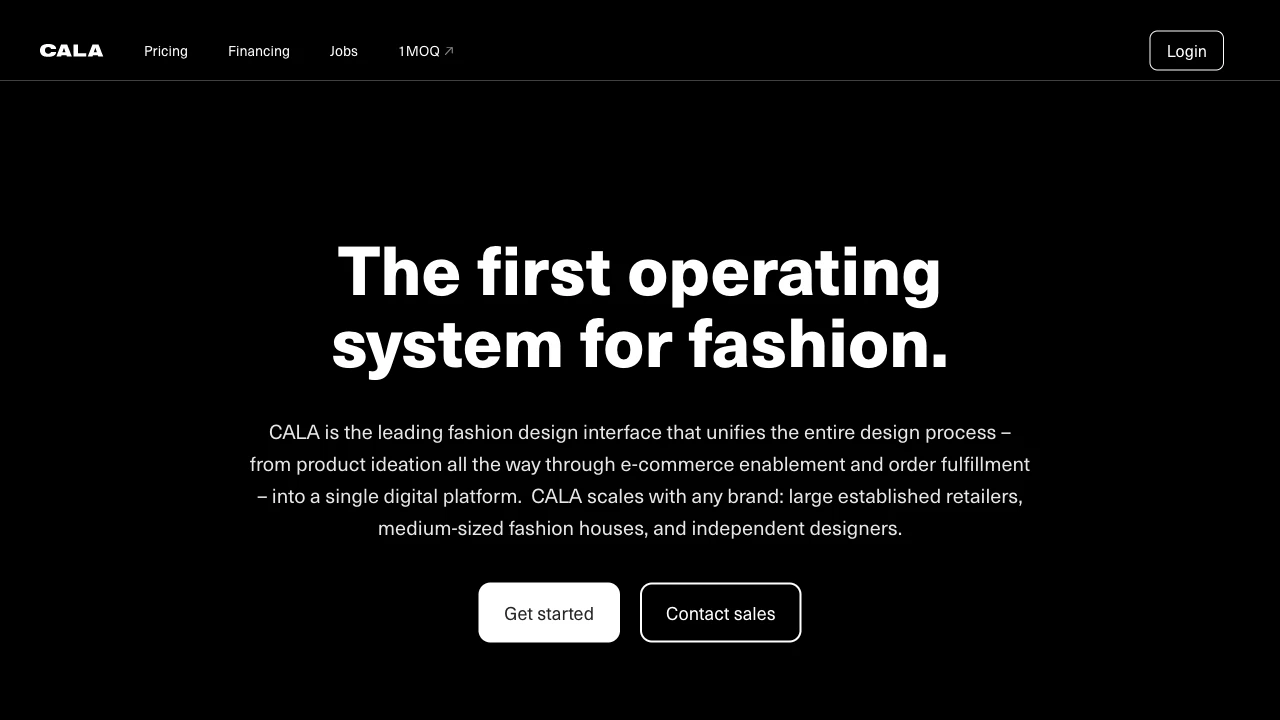
CALA and NAK3D target fashion brands with distinct strengths. CALA provides an end to end platform for design sourcing sampling and production with built in collaboration. NAK3D specializes in digitizing designs through 3D models data embedded tech packs and digital photoshoots for marketing and metaverse readiness.
Large established retailers
Medium-sized fashion houses
Independent designers
Collaboration with manufacturers
Comprehensive design tools
Seamless integration with manufacturing partners
Real-time collaboration features
Design assistance
Material sourcing
Sampling
In-app notifications
Task management
Fashion brands can digitize their designs for marketing purposes
Designers can create samples quickly without physical prototypes
Brands can showcase collections in virtual environments
E-commerce platforms can enhance their product listings with 3D views.
Streamlines design processes
Reduces costs associated with physical samples
Enhances product visualization for customers
Generates realistic 3D fashion models
Creates data-embedded tech packs
Conducts digital photoshoots
Facilitates digital transitions for e-commerce
Enhances brand representation in the metaverse
If your priority is an integrated end to end workflow from design to production with collaboration baked in, CALA is the stronger fit. If your priority is accelerating digital asset creation with realistic 3D models, data embedded tech packs and digital photoshoots for marketing and metaverse readiness, NAK3D is the better choice. For brands needing both capabilities, consider a staged approach or evaluate how these platforms could interoperate to cover both ends of the workflow.
CALA is listed as 0.00 freemium with monthly billing under a subscription model. NAK3D is listed as 0.00 paid with monthly billing under a subscription model. Both options emphasize accessible entry points and scalable value through ongoing subscriptions. The focus differs CALA emphasizes end to end workflows and collaboration while NAK3D emphasizes digital asset creation and virtual presentation.
No published speed or reliability metrics are provided for either tool. The descriptions emphasize workflow capabilities: CALA centralizes design collaboration across designers and manufacturers; NAK3D concentrates on AI driven 3D modeling and digital asset generation. Architecturally CALA appears to bundle design to production in a single platform while NAK3D builds specialized pipelines for 3D assets and data rich tech packs.
Both platforms are web based and target fashion brands. CALA leverages in app notifications task management real time commenting and an AI design tool to generate mood boards and ideas supporting collaborative workflows. NAK3D centers on easy creation of realistic 3D models data embedded tech packs and digital photoshoots to accelerate marketing and product storytelling. Onboarding expectations vary with team needs CALA may feel familiar to product teams seeking an integrated workflow while NAK3D may require familiarity with 3D assets and digital asset pipelines.
CALA notes seamless integration with manufacturing partners as a built in advantage. NAK3D does not list integrations in the description, focusing instead on asset creation and 3D tooling.
CALA excels at end to end workflow but relies on its partner network for production execution. NAK3D excels at digital assets but the description does not highlight built in end to end production management.