Sponsored by BrandGhost BrandGhost is a social media automation tool that helps content creators efficiently manage and schedule their social media... Visit now

ContextReply versus SuggestReply

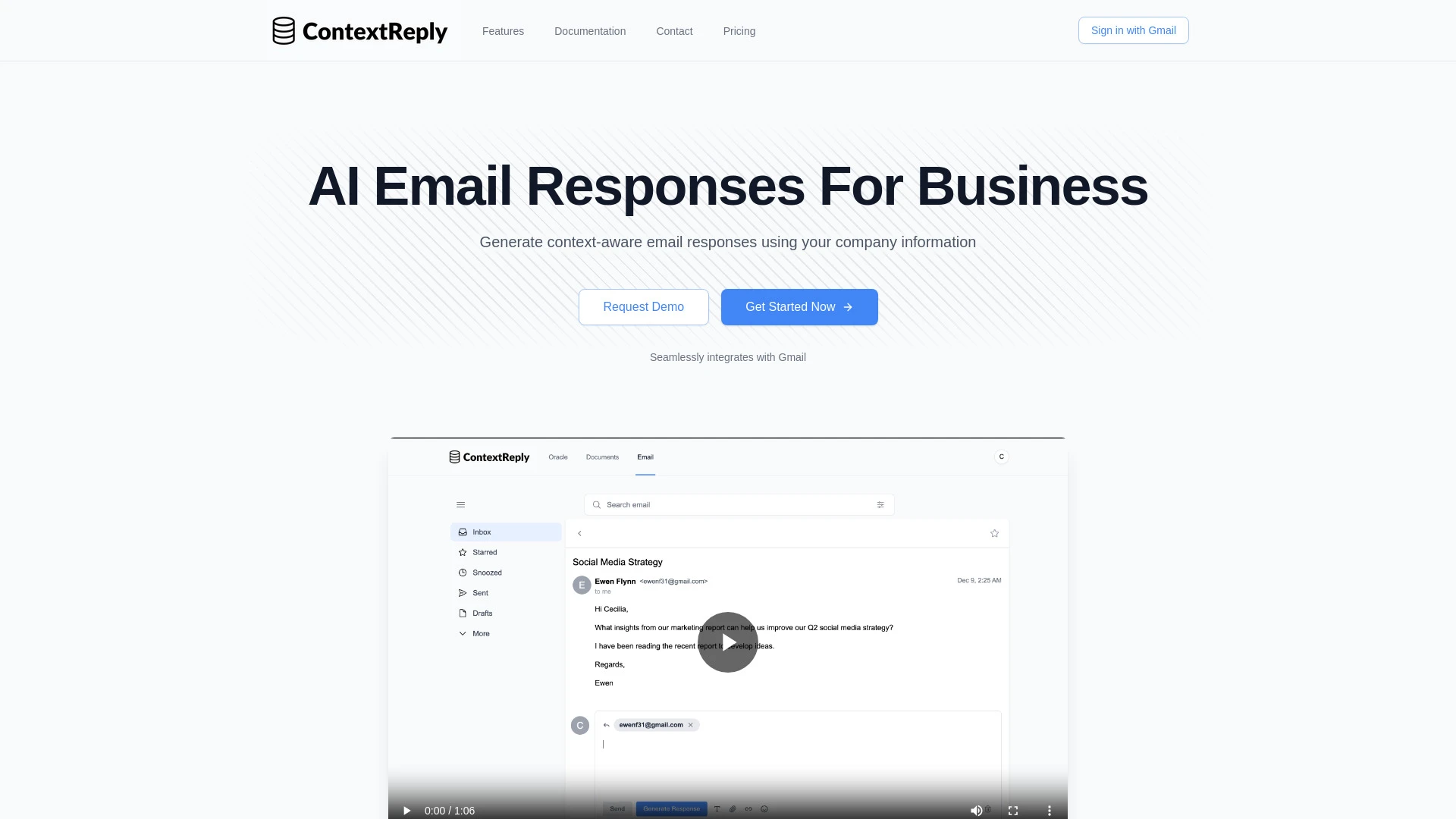
ContextReply and SuggestReply address different communication channels with AI driven replies. ContextReply targets email workflows with Gmail integration and enterprise level security, while SuggestReply focuses on social media engagement and brand voice alignment. Both aim to streamline interactions, each excelling in its native channel.

ContextReply vs SuggestReply Overview

Last updated: May 2026

ContextReply

0

Ideal For

    Generate replies for customer inquiries

    Automate follow-up emails post client meetings

    Standardize communication across teams

    Enhance customer service response times

Key Strengths

    Automates repetitive email tasks

    Enhances personalization in responses

    Saves time in email management

Core Features

    AI-driven email generation

    Seamless integration with Gmail

    Context-aware response automation

    Enterprise-grade security

    Customizable reply templates

SuggestReply

0

Ideal For

    Automate social media engagement

    Respond to customer inquiries

    Enhance brand interactions

    Increase customer satisfaction

Key Strengths

    Saves time on response generation

    Increases engagement rates

    Highly customizable to suit branding

Core Features

    Instant reply generation

    Customizable responses

    Tailored to brand voice

    Secure with Apple review

    Engages potential leads

Popularity

Very Low Unknown number of visitors
Growing popularity
Very Low Unknown number of visitors
Growing popularity

At a Glance

If your priority channel is email, ContextReply is the clear winner for delivering context aware, secure email replies at scale. For social media led engagement and lead generation, SuggestReply stands out with instant brand aligned responses and governance features. Consider a parallel pilot if your organization relies on both channels to maximize efficiency and customer touchpoints.

Pricing and Subscription Plans

Both tools offer a freemium price of 0.00 with a monthly subscription model. ContextReply emphasizes seamless Gmail integration and enterprise grade security as part of its value proposition. SuggestReply highlights brand voice customization and Apple reviewed security to support social media engagement and lead generation. The entry point is accessible for teams, with scalable capabilities as needs evolve.

Performance Metrics

No published speed or latency metrics are provided. Both are web based AI platforms designed to scale under a monthly subscription, with ContextReply stressing enterprise security and SuggestReply emphasizing brand voice and lead engagement as governance oriented strengths.

User Experience

ContextReply provides a user friendly interface and native Gmail integration, simplifying adoption for existing email workflows. SuggestReply guides users to input business details keywords and select posts to tailor responses, making setup straightforward for social media teams. Both are web platforms, supporting cross device access and straightforward onboarding, ideally via a pilot on the primary channel.

Integrations and Compatibility

ContextReply offers seamless Gmail integration as a core capability. SuggestReply is a web based tool focused on social media engagement with brand voice customization; no additional integrations are listed in the provided data.

Limitations and Drawbacks

ContextReply is specialized for email workflows which may limit cross channel usage without separate tools. SuggestReply centers on social media engagement and lead generation, so it may not fully replace email based processes.

Frequently Asked Questions

What is the main difference between ContextReply and SuggestReply?
The key difference between ContextReply and SuggestReply lies in their core use cases, pricing models, and feature depth. ContextReply typically focuses on specific workflows, while SuggestReply offers broader capabilities suitable for different teams and scenarios.
Which is better for teams: ContextReply or SuggestReply?
SuggestReply is often a better fit for growing teams that need collaboration, governance, and integrations, while ContextReply can be ideal for individuals or smaller teams who want a simpler, more focused solution.
Is ContextReply more affordable than SuggestReply?
Pricing depends on your usage and plan tiers. ContextReply may offer a lower entry price, while SuggestReply can provide more value at scale with advanced features included in higher-tier plans.
Can I use both ContextReply and SuggestReply together?
Yes, many teams combine both tools in their workflows to cover different use cases. Always review integrations and overlapping features to avoid paying twice for similar functionality.

Related Comparisons