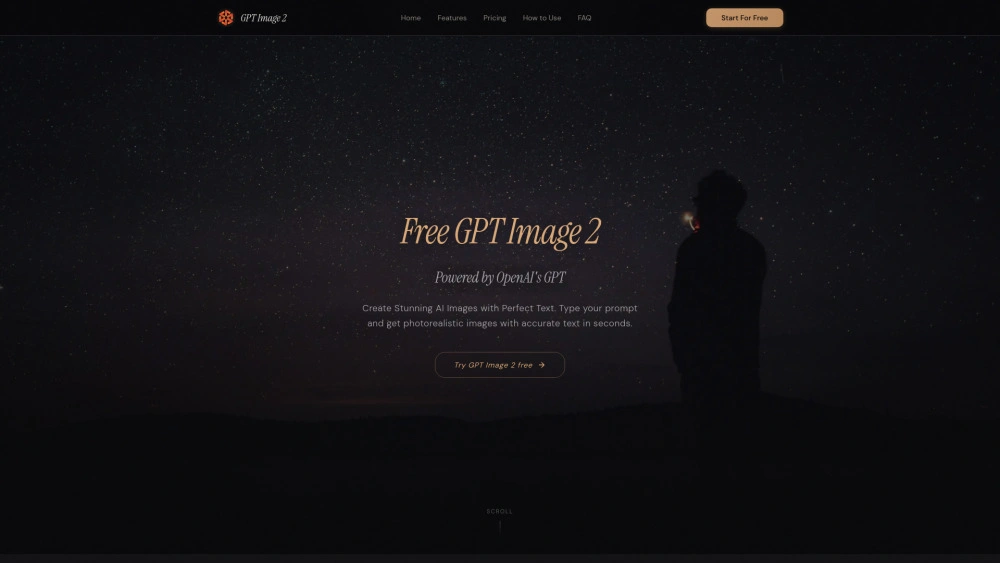
PhotoG and GPT Image 2 offer complementary strengths for visual content creation. PhotoG excels at real world product imagery with live scene customization, while GPT Image 2 delivers high fidelity text rendering and publication ready outputs for marketing and education. Both are web based and target designers marketers and product teams.
Creating marketing posters and social media graphics with readable text
Generating photorealistic e-commerce product photography and mockups
Designing logos and brand identity concepts with transparent backgrounds
Producing educational infographics and presentation slides with accurate labels
High-fidelity text rendering
4K, publication-ready outputs
Smart image editing (inpainting)
95%+ Text Rendering: Precise readable text in generated images
4K Output: Ultra-high-resolution visuals
Smart Inpainting: Edit images with natural language prompts
Transparent Backgrounds: Easy asset integration
Multi-Style Output: Photorealistic to illustration
Designers visualizing home decor projects
Online retailers showcasing products in customer environments
Marketers enhancing product presentations
Brands creating social media content
Rapid generative capabilities for product visualization
Versatile application across industries
High level of customization options
Generative image creation of real-world products
Instant visualization in any scene
Real-time control and customization
User-friendly uploading of items
Extensive scene templates
The winner depends on your priority. PhotoG shines for brand centric visuals with customization and asset storage, while GPT Image 2 wins for cost effective fast production with precise readable text and 4K outputs. For mixed workflows, adopting a blended approach can deliver both high fidelity visuals and publication ready text assets.
PhotoG costs 29.00 paid per month under a subscription plan reflecting its enterprise grade feature set for image generation scene visualization and storage. GPT Image 2 uses a freemium model with 0.00 price at entry and a subscription path for ongoing use. Both tools emphasize accessible web based workflows, with PhotoG offering a paid, feature rich plan and GPT Image 2 prioritizing low upfront cost and broad accessibility.
PhotoG emphasizes real time scene control and high resolution outputs as core capabilities though no speed metrics are published. GPT Image 2 leverages a GPT 4o backbone delivering 95%+ text accuracy and 4K output, indicating strong fidelity and reliability for publication ready visuals.
PhotoG provides an intuitive interface for uploading items and manipulating scenes in real time, with extensive scene templates and outputs that avoid watermarks, enabling rapid iteration for designers and retailers. GPT Image 2 is beginner friendly with simple prompts and publication ready visuals including transparent backgrounds and smart inpainting. Both platforms are web based, supporting quick onboarding for marketing teams and product designers.
PhotoG does not list explicit integrations in the provided data. GPT Image 2 states no direct integrations available.
PhotoG requires a monthly subscription which may be a consideration for small teams or individuals. GPT Image 2 lists no built in direct integrations, which can affect workflow if you rely on existing asset pipelines.