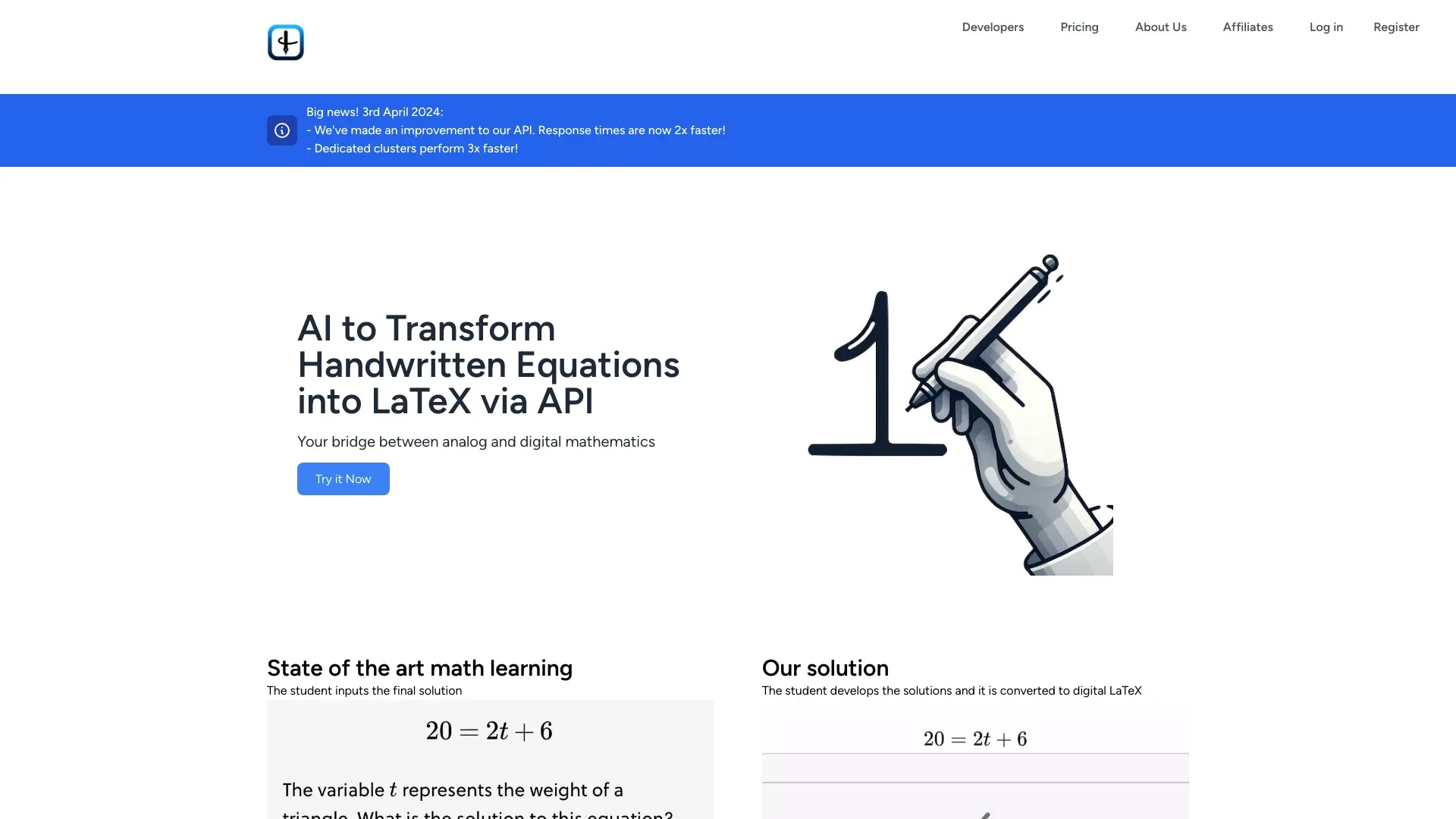
MathHandwriting specializes in transforming handwritten math into LaTeX via an API, ideal for educators, students, and researchers. Handwriting OCR provides AI powered handwriting recognition that converts notes and documents to digital text with broad applicability. Both tools target users who need to digitize handwritten content efficiently.
Convert handwritten lecture notes into digital text for easier study
Digitize historical documents for preservation and sharing
Enhance efficiency in data entry by processing handwritten forms
Aid researchers in compiling handwritten research notes into organized digital files
High accuracy in handwriting transcription
Saves time with fast processing
Offers flexible pricing plans
Accurate handwriting recognition
Fast conversion process
Multiple export formats (plain text, Word, PDF)
User-friendly interface
Robust transcription for various document types
Digitalizing handwritten math solutions
Assisting students with homework
Enabling educators to convert notes
Enhancing documentation with LaTeX
Easy conversion of handwritten notes
Saves time for educators and students
High accuracy reduces errors
Handwritten math to LaTeX conversion
API integration for developers
High accuracy in character recognition
User-friendly interface
Quick processing time
Best fit depends on use case: math to LaTeX workflows favor MathHandwriting as the clear winner, while general handwriting digitization leans toward Handwriting OCR. If both needs exist, a hybrid approach provides comprehensive coverage; MathHandwriting's freemium entry supports testing before committing to a paid plan.
MathHandwriting adopts a freemium model that starts at 0.00 and uses a monthly subscription for higher usage. This makes math to LaTeX conversion accessible to individuals and teams who want fast, accurate results with API access. Handwriting OCR is a paid monthly subscription at 29.00, offering fast conversions and multiple export formats including plain text Word and PDF. Together they present clear options for math specific workflows and general handwriting digitization.
Explicit speed benchmarks are not provided in the data. MathHandwriting emphasizes quick processing and high accuracy for mathematical symbols, while Handwriting OCR highlights fast transcription across document types. The underlying architecture appears web based and scalable, but concrete metrics are not published here.
MathHandwriting offers a user friendly interface and API for developers, enabling smooth integration into LaTeX workflows. Handwriting OCR also emphasizes a user friendly experience with straightforward export options. Both tools support web based access, making onboarding straightforward for educators, students, researchers, and professionals who digitize handwritten content.
MathHandwriting provides API integration for developers on a web platform. Handwriting OCR offers a web based interface with multiple export formats and easy integration into documents and workflows.
MathHandwriting focuses on math to LaTeX which may limit its applicability to non mathematical handwriting. Handwriting OCR is more general for transcription and may require additional steps for LaTeX ready math formatting when used in math heavy documents.