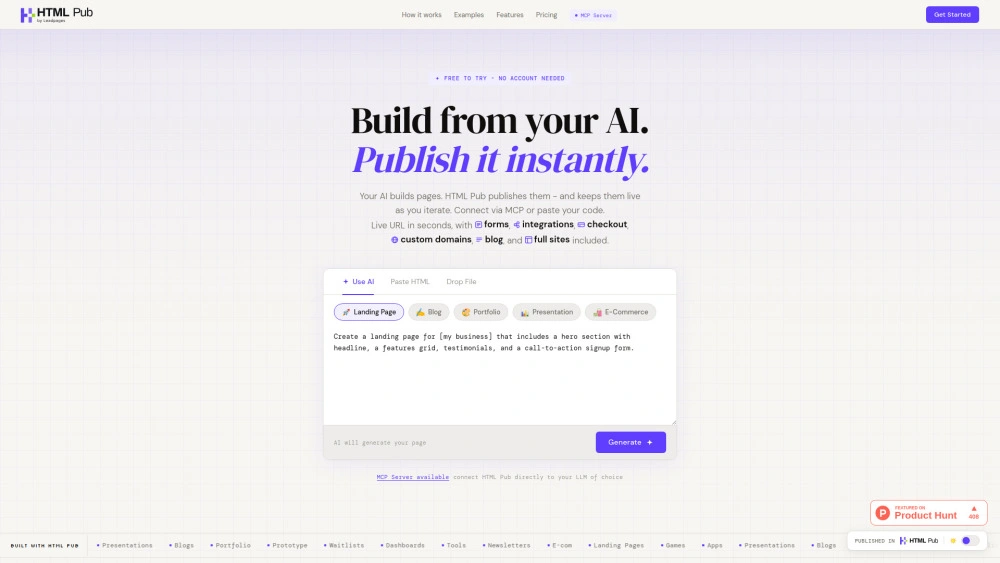
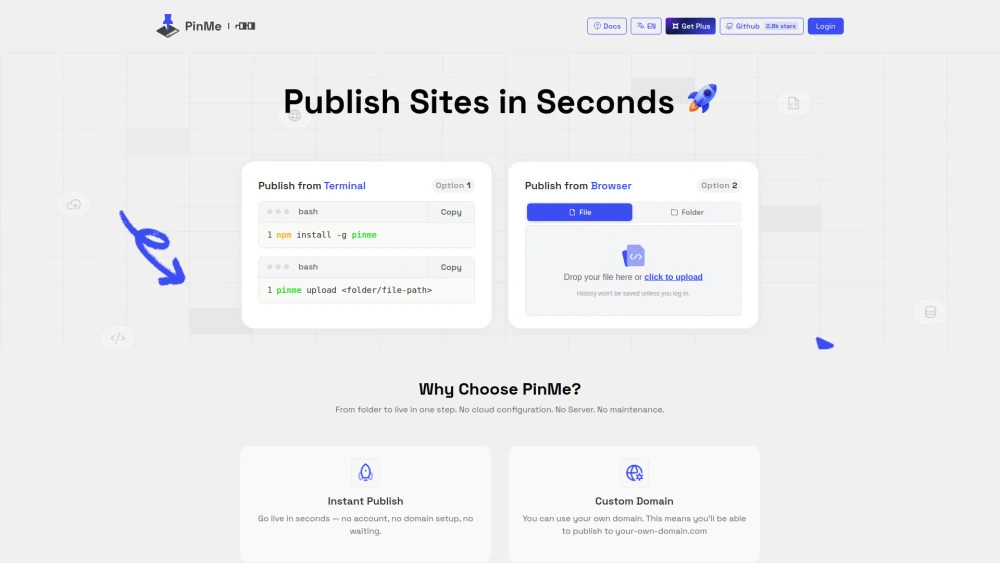
HTMLPub and PinMe offer ultrafast publishing with different architectures: HTMLPub focuses on AI powered website building with built in hosting and ecommerce integrations, while PinMe targets vibe coded pages for frontend demos with serverless deployment. Both provide freemium entry and beginner friendly experiences, but differ in hosting model and integration depth.
Rapid landing page deployment
Prototyping waitlists
AI-generated blogs with CMS
Simple ecommerce stores with integrated payments
Instant publish to live URLs
Built-in checkout for Stripe, Shopify, Gumroad, Lemon Squeezy
MCP Server integration enables publishing from AI tools
Instant MCP publishing: Publish from AI tools directly
Built-in hosting: Live URLs in seconds
Multi-page sites: Shared styles and navigation
Built-in forms & analytics: Capture leads and measure performance
AI-powered visual editor: Update pages with natural language
Creating client demo links
Testing side projects
Getting feedback on vibe-coded pages
Publishing portfolios and landing pages
Saves time: publish in seconds
Serverless: no hosting needed
Instant sharing: shareable links immediately
Publish in seconds: Instantly publish vibe-coded pages
Serverless deployment: Deploy from browser or CLI
Shareable links: Get a public URL instantly
No account required: Publish without signing up
Easy updates: Re-deploy changes in minutes
If your goal is a polished marketing site or ecommerce enabled pages with hosting and analytics, HTMLPub is the stronger choice due to its integrated hosting and payments ecosystem. If your priority is ultra fast client demos, prototype sharing, and zero hosting overhead, PinMe wins for speed and collaboration. Choose HTMLPub for ongoing site deployment and growth, or PinMe for rapid ideation, demos, and feedback cycles.
Both tools offer freemium access at 0.00. HTMLPub follows a traditional monthly subscription for its core hosting and publishing capabilities, including built in analytics and ecommerce integrations. PinMe uses a per_action billing approach alongside a subscription model, reflecting usage based costs beyond the free tier while enabling instant page publishing without account sign up. In practice, this means HTMLPub is strong for ongoing marketing sites and stores, while PinMe suits short term demos and client reviews with flexible usage.
Direct performance metrics are not published; both promise seconds level publishing: HTMLPub publishes live pages in seconds with built in hosting; PinMe publishes vibe coded pages in seconds with serverless deployment. Architectural stability comes from serverless deployment and hosted publish flows, which reduces deployment friction and supports quick iteration.
HTMLPub is beginner friendly with an AI powered visual editor and MCP publishing; it eliminates hosting complexity by providing built in hosting and live URLs. The onboarding is designed for marketers and bloggers who want quick launches and simple analytics. PinMe is also beginner friendly with no account required and both browser and CLI options; its shareable links and easy updates lower the learning curve for frontend developers and designers. Together they offer different entry points for fast publishing.
HTMLPub integrates with MCP Connector along with Stripe, Shopify, Gumroad, and Lemon Squeezy for payments and commerce. PinMe currently lists no direct integrations available, focusing on rapid publishing and sharing instead.
PinMe lacks direct integrations, which can limit ecosystem reach for complex workflows. HTMLPub relies on built in hosting and MCP ecosystem, which may constrain alternative deployment preferences or deeper customization.