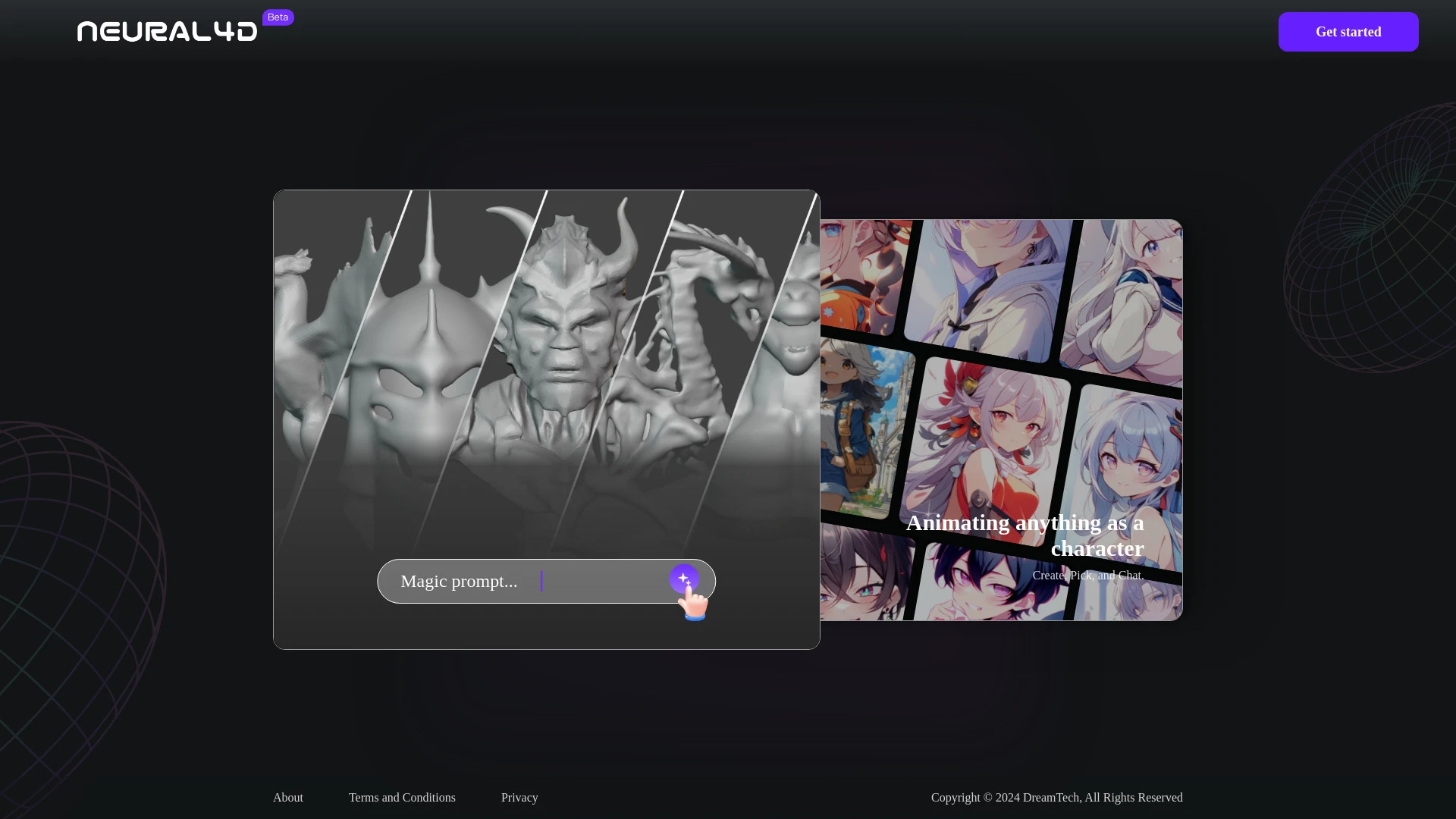
Neural4D and Neuralarts offer distinct paths for creative AI. Neural4D targets rapid 3D content generation for games and virtual environments, while Neuralarts provides a broad, beginner friendly suite for images videos music and voices. Each tool excels in its core area depending on the user's goals.
Designing 3D models for games
Creating virtual environments
Producing custom animations
Developing educational content
Fast content generation
High-quality 3D outputs
User-friendly interface
Text-to-3D generation
Image-to-3D conversion
Quick generation of high-quality 3D content
User-friendly interface
Supports animation creation
Digital art
Tech enthusiasts
Small businesses
Students and aspiring content creators
Comprehensive creative tools
Affordable pricing plans
Instant generation of content
AI image generation
AI video creation
AI music composition
AI voice synthesis
Instant content download
Portfolios focused on 3D content should favor Neural4D for speed and scalability. For broad creative tasks across images video music and voices with low entry cost Neuralarts is the better starting point. The best choice depends on your primary output, with Neural4D as the 3D specialized winner and Neuralarts as the versatile entry point.
Neural4D charges a 19 monthly subscription reflecting its specialized 3D workflow. Neuralarts uses a freemium 0.00 price point with a monthly subscription tier, providing instant content download. The pairing positions Neural4D as a focused option for 3D pipelines and Neuralarts as a low barrier entry for diverse creative work on the web.
Exact speed metrics are not published in the data. Neural4D highlights 3D generation in seconds, while Neuralarts offers instant content download; both rely on web based architectures designed for reliability and scalability.
Both platforms prioritize user friendly interfaces and quick onboarding. Neural4D is tailored for 3D prompts to generate models and animations, appealing to designers and developers. Neuralarts supports beginners and experienced creators with multi modality tools and an easy prompts approach, with instant downloads facilitating rapid experimentation.
Both are web based platforms with no explicit third party integrations listed in the data.
Neural4D excels in 3D but may be less suited for non 3D workflows. Neuralarts breadth can come at the cost of depth in any single domain.