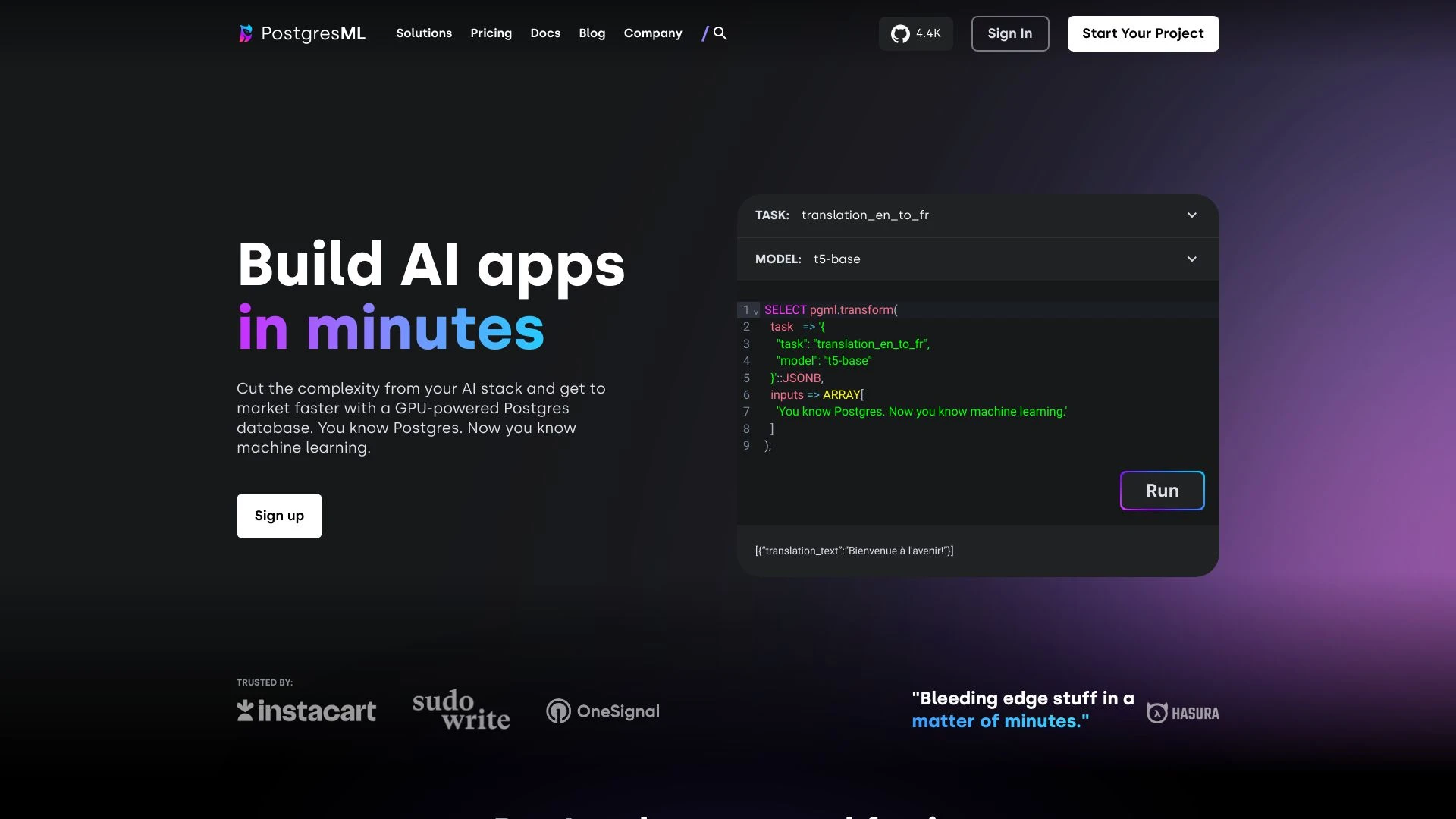
PostgresML and Neurelo address different layers of modern data apps. PostgresML embeds ML within PostgreSQL enabling in-database modeling and deployment, ideal for latency sensitive workloads. Neurelo offers AI powered API design on top of multiple databases, accelerating API creation and observability.
Building full stack applications quickly
Creating scalable serverless applications
Developing APIs for real-time data
Implementing complex database queries effortlessly
Simplifies database management
Accelerates app development
Provides AI assistance for API creation
AI-Powered REST and GraphQL APIs
Custom Query APIs with AI Aid
Query Observability
Schema as Code
Auto-Generated APIs
Smart toy chatbots
Site search optimization
Fraud detection in emergency services
Time series forecasting for business analytics.
Simple integration with existing databases
Cost savings by minimizing computational resources
Open-source flexibility
In-database MLops capability
High performance with low latency
Open-source with multiple ML libraries
Scalable architecture with custom Postgres pooler
Compatibility with leading ML toolkits
| Factor | Neurelo | PostgresML |
|---|---|---|
| Ease of Use |
|
|
| Features |
|
|
| Value for Money |
|
|
| Interface Design |
|
|
| Learning Curve |
|
|
| Customization Options |
|
|
Experts advise matching the tool to the data layer: use PostgresML for workloads that live inside PostgreSQL and require low latency ML in the database. For broader API needs across multiple databases and faster full stack API delivery, Neurelo is advantageous. In hybrid environments consider a staged approach where PostgresML handles in database ML while Neurelo exposes curated APIs to applications. Start with a small pilot project such as in database scoring with PostgresML and a companion API layer with Neurelo to assess integration effort and governance requirements.
Jamie Davis
Software Analyst
If your priority is in-database ML within a PostgreSQL ecosystem, PostgresML is the stronger fit. If you need AI assisted API design across multiple databases with rapid API deployment and observability, Neurelo is the better choice. For teams that require both in database ML and API driven access across databases, consider a dual-path evaluation and plan to leverage each tool for its strongest capability.
Both tools offer a freemium pricing tier starting at 0.00 with monthly subscription. This makes them accessible for experimentation and smaller teams while enabling upgrade for enterprise needs. PostgresML emphasizes cost efficiency through in database processing and open source flexibility, while Neurelo emphasizes rapid API development and cross database support.
PostgresML promises high performance with low latency by processing in database. Neurelo provides AI aided API generation with observability features that help monitor performance. The architectural approach supports stability through in database processing to reduce data movement and through AI driven API design for scalable serverless applications across databases.
PostgresML integrates as a PostgreSQL extension, so DB teams familiar with Postgres will find onboarding straightforward. Neurelo offers AI powered REST and GraphQL APIs and Schema as Code, enabling quick API setup and automated API generation. The Web based platforms cater to different roles data engineers for PostgresML and backend developers for Neurelo. Both provide guided workflows to accelerate projects.
PostgresML integrates with PostgreSQL and leading ML toolkits; Neurelo integrates with MongoDB Postgres and MySQL and offers observability and Schema as Code through GitSchema and auto generated APIs.
PostgresML is PostgreSQL centric which may limit cross database workflows. Neurelo reliance on AI generated APIs may introduce governance considerations for complex or evolving schemas.