Sponsored by BrandGhost BrandGhost is a social media automation tool that helps content creators efficiently manage and schedule their social media... Visit now

OpenArt versus OpenDream

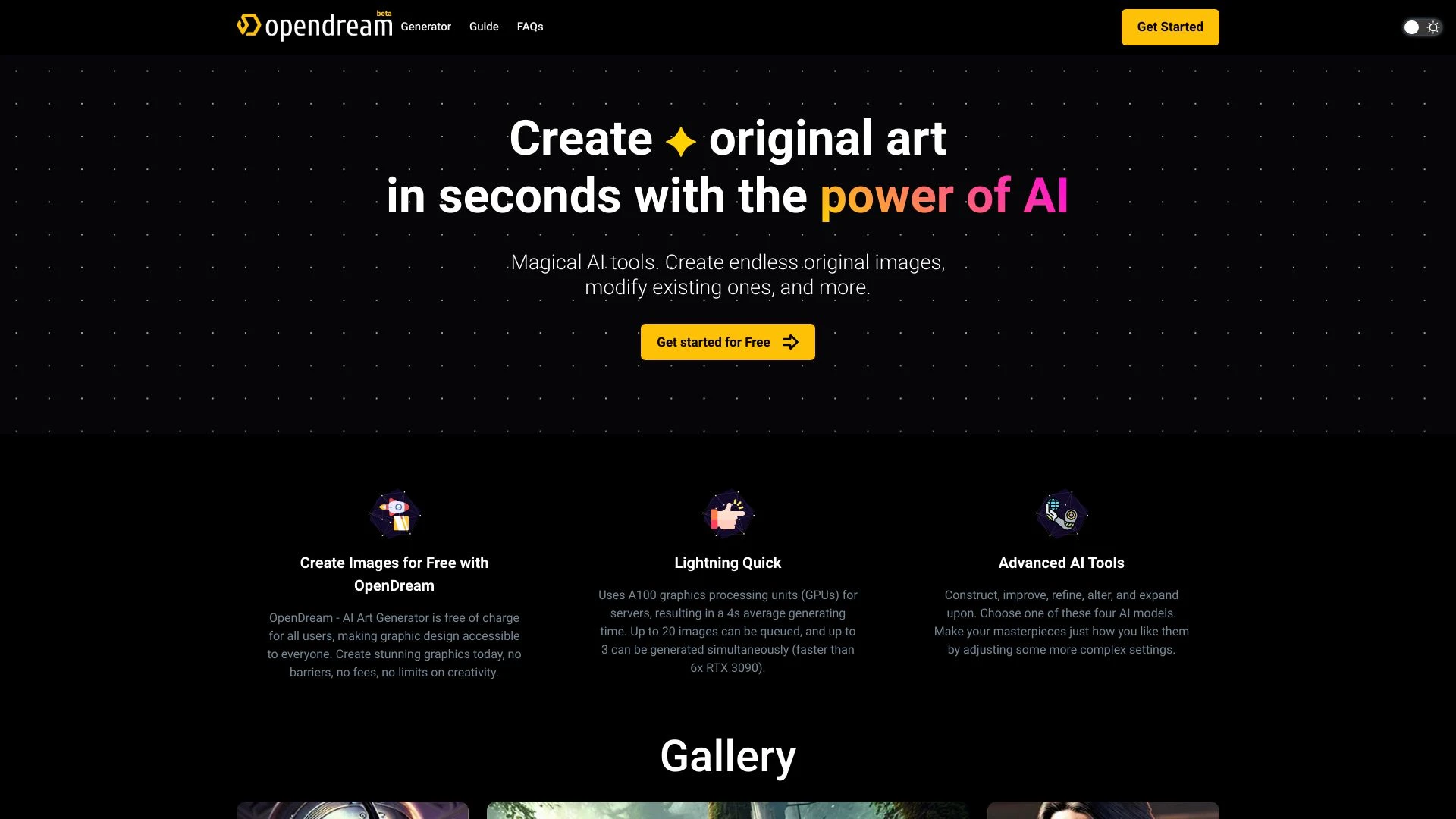
OpenArt and OpenDream are platforms for creators in the AI art space. OpenArt, launched in 2022, focuses on community-driven content and tools for artists, targeting hobbyists and professionals alike. OpenDream, established earlier in 2021, emphasizes storytelling through AI-generated art, appealing primarily to writers and visual storytellers. Both foster creativity but serve distinct audiences.

OpenArt vs OpenDream Overview

Last updated: March 2025

OpenArt

0

Ideal For

    Creating unique AI-generated artwork

    Generating customized anime characters

    Designing virtual avatars

    Developing gaming assets

Key Strengths

    Enhances creativity significantly

    User-friendly with minimal prompting

    Wide selection of AI models and styles

Core Features

    AI image generation with 20+ models

    Supports txt2img and img2img

    Face/anime enhancement up to 4x

    Inpainting capabilities

    Creative Variations for brainstorming

OpenDream

0

Ideal For

    Logo and icon design

    Stunning 3D artwork creation

    Anime-style illustration generation

    Cartoon character production

Key Strengths

    Instant artwork generation

    Easy customization options

    Access to commercial usage rights

Core Features

    Fast AI-driven image creation

    User-friendly interface

    Variety of customizable templates

    Multiple output options based on prompts

    Commercial rights for artwork

Popularity

Very High 6,200,000 visitors
Growing popularity
Medium 33,100 visitors
Growing popularity

Decision Matrix

Factor OpenArt OpenDream
Ease of Use
7.5/10
7.5/10
Features
8.0/10
8.0/10
Value for Money
8.0/10
8.0/10
Interface Design
8.2/10
8.2/10
Learning Curve
7.0/10
6.5/10
Customization Options
7.8/10
7.8/10

Quick Decision Guide

Choose OpenArt if:
  • You want intuitive controls for easy content creation.
  • You aim for high-quality artistic outputs in seconds.
  • You value extensive customization for unique results.
  • You look for collaborative features to enhance teamwork.
  • You desire regular updates with the latest AI advancements.
Choose OpenDream if:
  • You want seamless integration with existing workflows
  • You aim for fast and accurate content generation
  • You value customizable AI outputs tailored to your needs
  • You look for user-friendly interface with minimal learning curve
  • You seek robust support and active community engagement

What Our Experts Say

OpenArt excels in user-friendly design creation, making it ideal for beginners and small projects. Its intuitive interface fosters quick adoption. OpenDream, however, shines in complex, high-end applications, offering deep customization and advanced features suited for skilled users. Common challenges include OpenArt's limited scalability for large projects, while OpenDream may overwhelm new users. Each tool serves distinct needs effectively based on user expertise and project scope.
JD

Jamie Davis

Software Analyst

At a Glance

OpenArt excels in user-friendly interfaces and diverse art styles, making it ideal for casual users and educators. Pros include ease of use and varied outputs, while cons involve limited customization. OpenDream shines in AI-driven creativity, suitable for professionals needing high customization. Pros include robust features, while cons entail a steeper learning curve. For casual use, choose OpenArt; for advanced creative projects, opt for OpenDream.

Pricing and Subscription Plans

OpenArt offers a tiered pricing model starting at $10/month for individuals, scaling to $50/month for small businesses, with no additional fees. OpenDream, however, starts at $15/month for basic access, with a pro plan at $45/month and optional add-ons for premium features. For larger teams, OpenArt is more cost-effective, while OpenDream's flexible add-ons may benefit specific needs. Businesses should evaluate usage to choose the best fit.

Performance Metrics

OpenArt excels in speed, processing tasks quickly in real-time applications, while OpenDream offers superior accuracy in creative tasks. Reliability metrics are high for both, but OpenArt outperforms in time-sensitive scenarios, whereas OpenDream shines in detail-oriented tasks like intricate artwork generation. Choose based on your performance priorities.

User Experience

OpenArt features a sleek, intuitive interface with easy navigation and high customizability, allowing users to create tailored art experiences. Its learning curve is minimal, supported by comprehensive tutorials. In contrast, OpenDream offers a more complex interface that may pose challenges for new users, though it also specializes in unique artistic features. User support is available but less extensive compared to OpenArt, impacting overall user satisfaction.

Integrations and Compatibility

OpenArt seamlessly integrates with popular creativity tools like Adobe Creative Cloud and Figma, enhancing design workflows. In contrast, OpenDream connects with platforms like Trello and Slack, streamlining project management and collaboration. Both support major OS and browser compatibility.

Limitations and Drawbacks

OpenArt's limitations include a narrower range of styles and less customization. OpenDream suffers from slower processing times and occasional inaccuracies. Both lack extensive community support. Workarounds involve blending outputs or using additional tools for refinement.

Frequently Asked Questions

What is the main difference between OpenArt and OpenDream?
The key difference between OpenArt and OpenDream lies in their core use cases, pricing models, and feature depth. OpenArt typically focuses on specific workflows, while OpenDream offers broader capabilities suitable for different teams and scenarios.
Which is better for teams: OpenArt or OpenDream?
OpenDream is often a better fit for growing teams that need collaboration, governance, and integrations, while OpenArt can be ideal for individuals or smaller teams who want a simpler, more focused solution.
Is OpenArt more affordable than OpenDream?
Pricing depends on your usage and plan tiers. OpenArt may offer a lower entry price, while OpenDream can provide more value at scale with advanced features included in higher-tier plans.
Can I use both OpenArt and OpenDream together?
Yes, many teams combine both tools in their workflows to cover different use cases. Always review integrations and overlapping features to avoid paying twice for similar functionality.

Related Comparisons